
Polyurethane—Everything You Need to Know About This Plastic.
Explained quickly and easily.Published on August 10, 2026
Polyurethane (PUR) – A Concise Overview
Polyurethane (PUR) is a versatile plastic produced through the polyaddition of isocyanates and alcohols. It comes in three main forms: thermoplastic, thermosetting, and elastomer—each with specific mechanical properties. Depending on its composition, PUR is suitable for flexible, rigid, or elastic applications. Since its invention in 1937 by Otto Bayer, PUR has become established in numerous industries, such as insulation materials, tubing, shoe soles, automotive parts, and even the sports sector. Its particular advantages include its wide range of shapes, adjustable hardness (Shore A/D), durability, and—in the case of thermoplastic variants—good recyclability.
This technical article covers the following topics. Note: The individual bullet points contain hyperlinks to the respective sections:
What is polyurethane?
The word “polyurethane” alone reveals quite a bit about the material’s composition. The term is composed of the components poly (Latin for “many”) and urethane, which represents a specific chemical group (C3H7NO2). Ultimately, “polyurethane” means that many urethane groups are linked together. As simple as the term may be, the forms in which polyurethane can be found in practice are just as diverse.

Polyurethanes, often abbreviated as PUR (and sometimes as PU), are plastics or synthetic resins that are highly versatile. They are produced through a process known as polyaddition. In the polyaddition process, isocyanates are combined with alcohols, resulting in the formation of the many urethane groups that give the material its name. Depending on the composition of the individual components and the manufacturing method, the properties of the resulting plastic can vary significantly.
History of the Material
Although the material is at the forefront of many applications today, the history of polyurethane dates back to 1937. It was first synthesized by Otto Bayer in the laboratories of Bayer AG. However, the spread of polyurethane was initially slowed by World War II. As the economy recovered, however, the plastic quickly gained importance, and by 1960, 45,000 metric tons of it were already being produced. This figure, however, was just the beginning: in 2002, more than 9 million metric tons of polyurethane were produced worldwide. Studies from 2015 suggest that the global market for polyurethane now generates annual sales of around 50 billion euros.
Different Types of Polyurethane
As mentioned at the beginning, polyurethane can exhibit many different characteristics. To help navigate these, it is useful to categorize it into thermoplastics, thermosets, and elastomers. This classification is commonly used for various plastics and is particularly important when searching for the right material.
Thermoplasts: Thermoplasts can be reshaped by heating them even after they have been manufactured. This means the material’s properties change with varying temperatures. As a rule, thermoplasts become harder as the temperature drops and
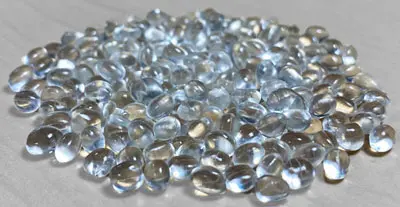
softer as the temperature rises. This can be compared to chocolate: When a chocolate Santa Claus is molded, it is solid at room temperature or cooler and retains its shape. However, it would be easy to remelt the Santa Claus by heating it and reshape the chocolate mixture into an Easter bunny.
Thermosets: Unlike thermoplastics, thermosets cannot be reshaped once they have been initially molded. They generally have a higher hardness and are therefore particularly well-suited for molded parts. As an analogy from the culinary world, thermosets could be compared to cake batter. At first, it is liquid (or at least viscous). Once the cake is baked in its pan, it becomes solid. No matter how much you heat or cool the cake, it will not return to a liquid batter.
Elastomers: Although elastomers retain their shape, they remain elastic over a wider temperature range. This means they can be deformed by tension or compression but always return to their original shape afterward. Colloquially, polyurethane elastomers are therefore also referred to as “rubber polyurethane.”
Different degrees of hardness in polyurethane
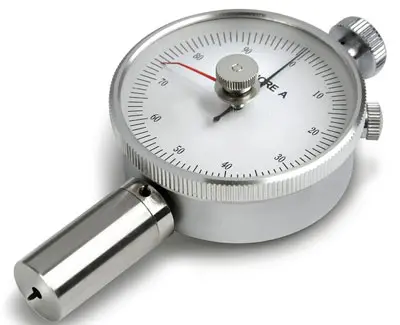
The degree of hardness plays a crucial role in selecting the right polyurethane material. Should the material be more flexible or more rigid? The so-called Shore hardness provides an overview of this question. It quantifies how hard one material is compared to another. Shore hardness is determined by pressing a standardized test specimen into the material under test with a specific force. The Shore hardness is determined based on the depth to which the test indenter penetrates the material, using a measuring instrument called a durometer.
There are various scales for Shore hardness. For plastics, the Shore A through Shore D scales are traditionally used. Shore D is significantly harder than Shore A. The designation is supplemented by a number preceding the letter of the scale. The higher the number, the harder the material. A complete specification of the Shore hardness could therefore be, for example, Shore 80 A. The Shore A and Shore D scales overlap within a certain range: Shore 80 A, for example, corresponds approximately to Shore 36 D.
Advantages Over Other Materials
The greatest advantage of polyurethane lies in its versatility. The material can be molded into various shapes with little effort. Thermoplastics and elastomers, for example, are suitable for applications where a certain degree of flexibility is essential. Thermosets, on the other hand, can withstand greater loads due to their higher degree of hardness. Components made of polyurethane are suitable for lightweight construction and, in most cases, do not require environmentally harmful plasticizers. Added to this is the durability of polyurethanes due to their high abrasion resistance and good recovery properties. Here is a detailed comparison of polyamide vs. polyurethane.
What is polyurethane used for?
One of the material’s key strengths is its versatility. Although it has become an indispensable part of modern daily life, its specific applications are still relatively unknown:
Use as an insulating material: Polyurethane has very low thermal conductivity and is therefore ideal as an insulating material. Another advantage of this plastic is the ease with which polyurethane foams can be manufactured in various shapes, allowing it to be used in refrigerated trucks, building insulation, and many other applications.
Polyurethane in extrusion: Thanks to their good formability at higher temperatures, thermoplastic polyurethanes are ideally suited for processing via extrusion. In this process, the plastic is heated and forced under pressure through a shaping die. This method is used, for example, to produce PUR tubes, which are used in many industrial sectors to reliably transport air or other media from point A to point B (more on compressed air tubing). In addition, the process is ideally suited for the production of oil scrapers made of polyurethane.


Polyurethane in Sports and Leisure: Until the 1970s, traditional leather was still the dominant material used in the manufacture of fottballs. Nowadays, however, many models are made by bonding multiple layers of polyurethane. This has the advantage of creating a seamless surface that absorbs significantly less water than comparable leather balls. But it’s not just the balls—many football cleats are also largely made of polyurethane these days. You can even find this versatile plastic in the cushioning foam soles of running shoes.
Polyurethane in the automotive industry: Components made of polyurethane are also widely used in car models ranging from compact cars to luxury vehicles. Whether it’s trim elements for door panels or dashboards, PUR foams in the seats, pneumatic tubing for controlling active aerodynamics, or massage seats in premium models—almost anything is possible.
Nevertheless, all of this represents only a small fraction of the possible applications for this versatile plastic. Listing all areas of application, however, would go beyond the scope of this overview.
Is polyurethane recyclable?
The question of whether polyurethane is recyclable is not so easy to answer. This is because the various forms of the plastic discussed earlier—thermoplastics, thermosets, and elastomers—vary in how difficult they are to recycle.
Thermoplastics are the easiest to recycle: Since, as the name suggests, they can be reshaped at high temperatures, thermoplastic polyurethane is relatively easy to recycle. If the material is not overly contaminated with additives during its initial molding, it can theoretically be simply melted down and reprocessed. However, this requires a bit more expertise than it might sound at first glance.
The situation is different for thermosets and elastomers compared to thermoplastics. Once they have been initially shaped, they can no longer be reshaped simply by heating. However, even waste from these types can still be put to good use through recycling: Thermosets and elastomers can be ground up and mixed with new polyurethane, thereby significantly reducing the amount of raw materials used. In addition, there are chemical recycling processes that can break polyurethane down into its individual components.
The initial question, “Is polyurethane recyclable?” can therefore be answered with a clear “yes.”
Summary
Polyurethane is a highly versatile plastic that exists as thermoplastics, thermosets, and elastomers. It is produced by combining isocyanates and alcohols (polyaddition). The material is used worldwide in many everyday applications, often going unnoticed. Whether in thermal insulation, the automotive industry, or on a soccer field, polyurethane offers advantages over other materials. When searching for the right material, not only is the type (thermoplastics, thermosets, elastomers) of particular importance, but also the degree of hardness. This is measured using the so-called Shore hardness scale. Polyurethane is generally recyclable, even though the process requires a certain level of expertise.
FAQ on Polyurethane
Is polyurethane toxic?
No, when polyurethane is in its cured form, it is not toxic. Furthermore, it generally does not contain any plasticizers that could leach out of the material. Therefore, when used properly, it is considered safe and is even used in some applications in the food and medical industries. However, if processed incorrectly (heated too much), gases may be released that could be harmful to health in some cases.
What are the advantages of polyurethane?
Compared to other materials, polyurethane is extremely versatile. Thermoplastics and elastomers are characterized by their flexibility. Thermosets, on the other hand, can be very hard and can therefore withstand heavy loads. In general, polyurethane is considered very robust and durable.
What are the disadvantages of polyurethane?
One of the biggest drawbacks of polyurethane compared to many other plastics is its price. Since it is a very high-quality material, many comparable plastics are less expensive.
How durable is polyurethane?
In general, polyurethane is considered to be very durable. Its actual service life depends heavily on the application. But even under heavy loads, polyurethane stands out for its durability compared to other plastics.
Is polyurethane biodegradable?
No, polyurethane is not generally biodegradable. Under natural conditions, it takes several decades to decompose. However, there are some specific types of the material that can be broken down by enzymes and microbes. In addition, thermoplastic types of polyurethane are highly recyclable.

Dan Biebl
Managing Director
I hope you found our article helpful!
Here at PAPUREX, we’re here to help you find the right Tube for your specific applications. Do you have any questions about the article? Feel free to contact me!
By email at dan.biebl@papurex.de
Or by phone: 06209 72102 40
Any questions?
At PAPUREX, we specialize in processing polyurethane into high-quality Special Tubing.