
Polyamide vs. Polyurethane
Comparison of the materialsPublished on July 2, 2026
Plastic hoses for industrial applications are largely made of polyamide or polyurethane. Both are polymers—that is, chemical substances consisting of macromolecules. However, these two polymers have some differences. Polyamide vs. polyurethane is not a question of good or bad, but rather of suitability or unsuitability. Read our product comparison to find out why:
Polyamide
Polyamide is much harder than polyurethane. For this reason, it can withstand higher pressures and is generally more robust. However, the material’s hardness also has some drawbacks. In many cases, polyamide tubing is so hard that it behaves more like a pipe than a tube. This can lead to installation problems when space is limited, since the bending radius of polyamide tubing is many times greater than that of polyurethane tubing.
Furthermore, polyamide tubing kinks if the bending radius falls below the minimum allowable value. This leaves a distinct kink that acts as a predetermined breaking point during further use. To make polyamide slightly more flexible, plasticizers are often used. This results in a shorter service life for the products, as the plasticizers evaporate over time. Furthermore, the use of plasticizers renders polyamide tubing unsuitable for many applications in sensitive areas.
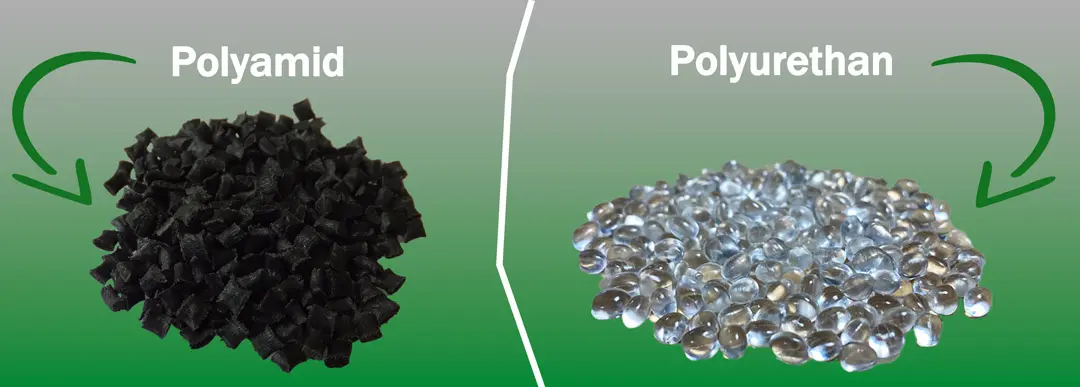
Polyurethane
Compared to polyamide, polyurethane is significantly softer. This generally makes the material slightly less robust. Polyurethane tubing therefore withstands slightly less pressure than its polyamide counterpart. However, given that most pneumatic applications operate at pressures between 6 and 12 bar—which polyurethane tubing can easily withstand—this difference is negligible. Due to the material’s inherently soft nature, polyurethane tubing does not require plasticizers. As a result, this tubing can also be used in medical technology or the food industry. Furthermore, the absence of plasticizers leads to a longer service life compared to polyamide tubing. The greater flexibility also allows for use in significantly tighter spaces due to smaller bend radii.
| Polyamide | Polyurethane |
|---|---|
|
|
|
|
Polyamides vs. Polyurethanes – We’ve Made Our Choice.
When PAPUREX W. Büchner GmbH first began operations, it processed both materials; however, due to the advantages described above, the company specialized in the production of high-quality polyurethane tubing. The focus on polyurethane that came with this specialization has enabled continuous quality improvements, further development, and innovation over the years. All PAPUREX polyurethane tubing is compatible with push-to-connect fittings. These particularly time-saving hose connectors are the current gold standard in the industry. Since PAPUREX ensures both internal and external calibration, the push-to-connect fittings can be routed internally or externally as needed.
Any questions?
Don’t hesitate to give us a call – we are happy to advise you.
