
Compressed Air Tubing—Find the Best Ones Easily.
The right tube saves time, stress, and money.Published on August 13, 2026
Compressed Air Tubing – A Brief Introduction:
Compressed air tubing must meet different requirements depending on its application. Key factors include the maximum operating pressure, the tubing length, the required flexibility, and any additional requirements such as resistance to UV light, moisture, abrasion, or flying sparks. Careful selection ensures a long service life and cost-effective operation.
Taking these factors into account before purchasing can save costs and resources. Expert advice—for example, from the manufacturer—helps ensure that you find the optimal tube for your specific application.
Compressed air tubing is versatile
Compressed air tubing is used in many different fields. For example, various tools such as impact wrenches, drills, and grinders—as well as agricultural tools like pruning shears—can be powered by compressed air. Compressed air tubing is also indispensable in many areas of mechanical engineering and the automotive industry. To deliver the air required for the job precisely to where it’s needed, you need the right compressed air tubing. In technical circles, the use of compressed air to perform tasks is referred to as pneumatics. For this reason, compressed air tubing is often also called pneumatic tubing.
The requirements for compressed air tubing are as varied as their areas of application. To find the right compressed air tubing, the required properties should be determined in advance. With a little prior knowledge, anyone can purchase the right compressed air tubing and save both time and money.
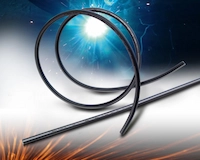
flamex® flame-retardant tube
flamex® has proven itself over more than 20 years of use in various industries. The pneumatic tubing is typically used near welding robots.
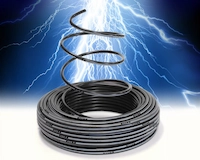
A:S:S® Antistatic Compressed Air Tubing
A:S:S is an antistatic tube with a surface resistance of up to 1,000 kΩ. It is used in the production of sensitive electronics or in areas at risk of explosion.

KSS: Kink-resistant compressed air tubing
KSS is a kink-resistant compressed air tubing. Thanks to its internal profile, it ensures a consistent flow rate no matter how small the bend radius is. KSS is used in situations where space is limited.
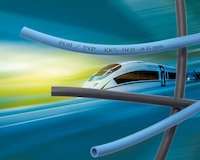
KKS: for aviation and rail transport
KKS has been specifically developed to meet the fire protection requirements (DIN EN 45545) of the aviation and rail industries. It is suitable for use with many different media.
Advantages of Compressed Air
Air Is Available Everywhere
The most important factor in compressed air applications is, of course, air. Since it is readily available in almost any environment, compressed air can be used to perform work in most locations without any special precautions. In addition, exhaust air can simply be vented after use because compressed air applications do not produce any hazardous substances.
Compressed air is cleaner than its alternatives
The most obvious alternative to compressed air is the use of hydraulics. In hydraulics, fluids are used to perform the desired task. Oils are often used in this process. If a leak occurs in a hydraulic line, the fluids used are released into the environment. In contrast, if compressed air tubing or a fitting leaks, only air escapes. In areas where cleanliness is a top priority, compressed air applications therefore have a clear advantage.
Compressed air applications are safe
Because they do not involve hazardous substances such as oils, compressed air applications are very safe. They can therefore also be used in areas where there is a risk of explosion or fire. In addition, the components of compressed air systems are subject to minimal wear and tear. Once you have found the right compressed air tubing, it will last for thousands of operating hours if handled properly. Compressors and pistons, which are needed to generate the desired pressure, are also relatively resistant to wear and tear.
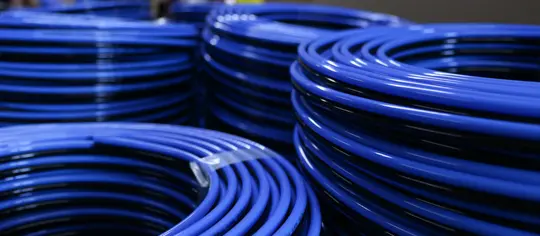
Compressed Air Tubing – These Features Are Important
Pressure Resistance
Arguably the most important factor when selecting compressed air tubing is its pressure resistance. Before installation, you should therefore determine the working pressure required for the system. If you’re unfamiliar with the terms “working pressure” and “burst pressure,” you can find more information on this topic in the article Burst Pressure vs. Working Pressure. For most applications, a pressure of 6 bar is sufficient. This is a pressure that most compressed air tubing can withstand without any major issues. However, some high-pressure applications require pressures of around 18 bar. In exceptional cases, pressures as high as 40 bar may even be necessary to perform complex tasks. When installing compressed air tubing, it is recommended to allow for a sufficient margin of safety in terms of pressure resistance to ensure safe and long-term use.
The Correct Length of Compressed Air Tubing
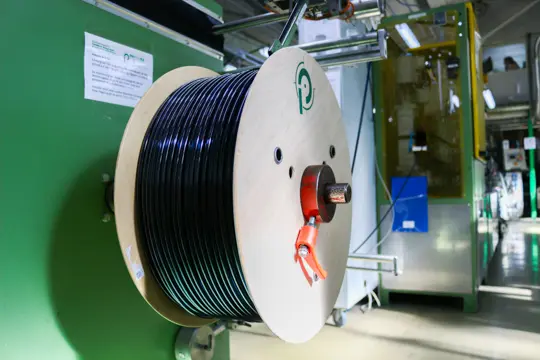
It may sound trivial, but it’s nevertheless of great importance for the application. Compressed air tubing should be neither significantly longer than necessary nor too short. Excess length primarily results in the extra tubing getting in the way, which makes handling it much more inconvenient. If you still want to be mobile with your compressed air application—such as when using an air blow gun—we recommend using tube spirals. These can be extended to their maximum working length as needed and conveniently retract when not in use. This prevents tripping hazards and thus reduces the risk of system failure. However, compressed air tubing should not be shorter than necessary either. If too many individual tubes must be connected to one another, the risk of failure also increases, since connectors always represent a weak point in the system. Compressed air tubing is available in every conceivable length, ranging from a few millimeters to up to 1,000 meters in a single piece. This means there should be a suitable length for every purpose.
Flexibility
Flexibility is an important characteristic of compressed air tubing. However, more flexibility isn’t always better. High flexibility is often achieved by using soft materials and thin walls. This, in turn, comes at the expense of pressure resistance. For more information on the flexibility of compressed air tubing and how to compare it across different products, see our detailed article on flexibility.

AgrarPur® - Developed for Agriculture
AgrarPur was developed to withstand environmental conditions. Its primary application is therefore in agriculture.

Standard polyester-based compressed air tubing
Polyester-based compressed air tubing is extremely pressure-resistant across a wide temperature range. It also offers good flexibility and abrasion resistance.

Standard polyether-based compressed air tubing
Polyether-based compressed air tubing is very versatile. In addition to its good mechanical properties, it is resistant to hydrolysis and microbes.
Special operating conditions require special compressed air tubing
The applications for compressed air tubing are extremely varied. Unfortunately, it is still common practice to use the same tube—often the cheapest one—for all of these applications. What often seems like a bargain at the time of purchase can quickly have a negative impact on costs due to frequent failures. The following factors can significantly influence the service life of compressed air tubing:
- UV radiation: UV radiation not only causes many tubes to fade but also makes them brittle. This significantly reduces their service life. The UV resistance of compressed air tubing can be significantly improved by using the right additives and materials.
- Hydrolysis and Microbes: Many plastics are susceptible to hydrolysis or to microbes found in liquids. As a result, the material loses its durability. Certain materials, such as polyether-based polyurethane, are significantly more resistant in this regard.
- Abrasion: Not every compressed air tubing is suitable for high-friction applications, such as use with drag chains. Selecting the right material can significantly reduce abrasion damage
- Bend radii that are too tight: If there is very little space to route compressed air tubing, many standard hoses will kink. Even if installation is successful afterward, the kink often creates a predetermined breaking point. Particularly flexible or even kink-resistant variants can help in this situation.
- Sparks: Compressed air tubing is often used in production facilities where welding robots are also in operation. Sparks can cause significant damage to many plastics. In these cases, flame-retardant compressed air tubing can significantly extend maintenance intervals.
- Static charge: Static charge often occurs when different media are transported through a Tube or rub against its outer surface. In sensitive areas such as the production of delicate electronics, this can lead to damage. In potentially explosive atmospheres, the buildup of static charge can even be life-threatening under certain circumstances.
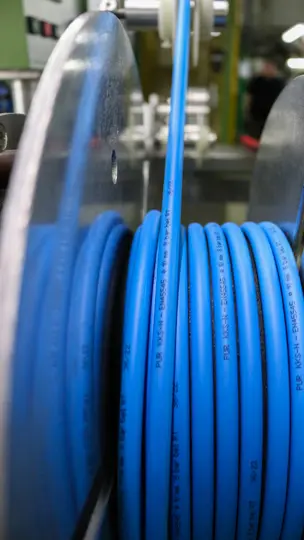
The Right Compressed Air Tubing Saves Resources
The use of compressed air to perform work is also referred to as pneumatics. Compressed air applications offer several advantages over alternatives such as hydraulics. The most notable of these are the easy availability of air, the clean operation, high safety, and low wear.
When selecting the right compressed air tubing, there are important key characteristics that should not be overlooked:
- Pressure resistance: What pressures must my tubing withstand?
- Length: What distance do I need to cover with my compressed air tubing?
- Flexibility: How much space do I have to route the tube?
- Special requirements: Are there any special conditions at the compressed air tubing’s point of use, such as UV radiation, moisture, abrasion, flying sparks, or a risk of explosion?
If these questions are addressed before installing compressed air tubing, valuable resources can be saved thanks to increased durability. Ideally, contact a manufacturer you trust to find the right compressed air tubing for your application. Act now and buy the right compressed air tubing for your application!
FAQ on Compressed Air Tubing
How are compressed air tubing connections made?
In most cases, compressed air tubing can be connected to one another quickly and easily using quick-connect fittings. However, if operating pressures rise significantly above the standard 6 to 8 bar, threaded fittings may be necessary to ensure the system remains leak-free. Our article on tubing connectors covers this topic in detail.
What types of compressed air tubing are available?
- Compressed air tubing is available in a variety of types. These include:
- Tubing sold by the meter (coils, usually 25 or 50 m)
- Tube sections (shorter lengths ranging from a few millimeters to several meters)
- Spiral tubes
- Multi-line tubes (several lines connected into one)
What sizes is compressed air tubing available in?
The standard dimensions for compressed air tubing range from 3 x 1.8 mm to 16 x 11 mm (outer diameter x inner diameter). Smaller and larger sizes are certainly possible and available upon request.
What types of hoses are suitable for compressed air?
In general, tubing made of many types of plastic is suitable for compressed air applications. Examples include polyurethane and polyamide. It is important that the tube can withstand the operating pressure of the application. Standard operating pressures are usually between 6 and 8 bar. In addition, you should consider which environmental factors (water, UV radiation, friction) will affect the tube. The article above this FAQ provides a comprehensive guide to determining which tube is best for which application.
What is the significance of the colors of compressed air tubing?
The colors of compressed air tubing have no specific meaning. They are often used to distinguish between different hose lines. This can be particularly helpful in complex systems with many lines, for example, when searching for leaks or replacing lines. However, aesthetic color schemes—such as matching the company’s corporate colors—are also possible.

Dan Biebl
General Manager
I hope you found our article helpful!
Here at PAPUREX, we’re here to help you find the right Tube for your specific applications. Do you have any questions about the article? Feel free to contact me!
By email at dan.biebl@papurex.de
Or by phone: +49 6209 72102 40
More information about compressed air tubing
Do you have any questions? Our compressed air tubing experts will be happy to help!