
What Is the Purpose of a Multi-Tube?
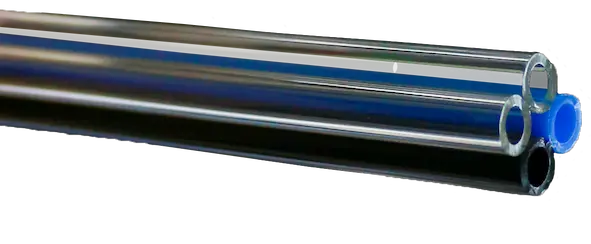
A multi-tube refers to a configuration where multiple tube lines are combined into a single unit. This offers a significant advantage during installation. For example, if four tube lines need to be routed through a pipe, using individual tubes would require four times the effort. Each tubing piece must be threaded through the pipe and connected individually. However, if the tubing lines in a multi-tubing assembly are already connected to one another in advance, a single threading operation is sufficient.
Why not simply use a single large tubing piece instead of a quad tubing piece?
If we consider only the volume, one could simply choose a larger tubing piece instead of connecting multiple tubing lines together. For applications that only need to route a single medium to a single connection, this is indeed the more efficient option. However, complex machines often have various connections. For example, a pneumatic gripper used for assembling small parts requires various connections for Pneumatic tubing:
- Line for compressed air to open the gripper
- Line for compressed air to close the gripper
- Line for compressed air to swing the arm
- Line for compressed air to return the arm
All these movements are performed by pneumatic components in a very confined space. However, they have individual connections. Furthermore, they must function independently of one another. Simply installing a large tube assembly is therefore not practical in this case. If you install a quad tube instead, you still only have to deal with the installation effort once, but you can operate each individual connection separately.
Quad tubing already exists—so what’s new?
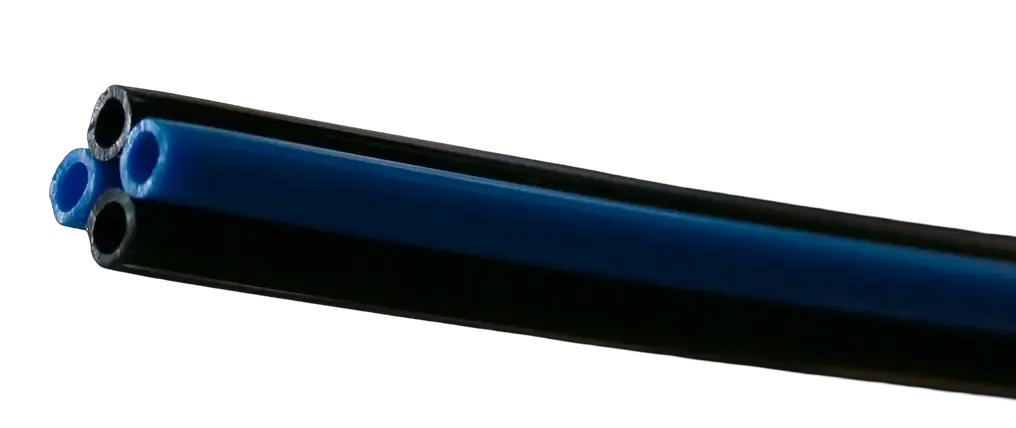
Multi-tubing assemblies are not a new invention. PAPUREX has been offering this variant for polyurethane tubing for decades. Many suppliers have duo tubing in their portfolios. The selection of trio tubing is somewhat more limited—not to mention quad tubing. However, PAPUREX has been pioneering the field of multi-port tubing for years. The tubing manufacturer from the Odenwald region has even produced a seven-port tubing unit in response to customer requests. All these special types of multi-port tubing were, however, arranged side by side. This is because producing other configurations is technically very complex. With the new quad-tube, however, PAPUREX has succeeded in realizing a “square” arrangement. Instead of a row of four tubing lines, these are now connected in a 2 x 2 configuration.
What advantage does the new geometry of the quad-tube offer?
Space is at a premium in complex systems. When multiple tubes are connected in series, they take up a lot of space on a single plane. For a quad tube consisting of individual tubes with an outer diameter of four millimeters, this amounts to 1.6 centimeters. With the “square” arrangement of the quad tube, however, the maximum space required is only half as much—0.8 centimeters—because the tube lines are distributed across multiple planes. This allows the innovative multi-tube to fit through much narrower pipes and conduits, whose round shape harmonizes significantly better with the “square” arrangement than with the conventional in-line welding.
Another advantage of the new geometry is that the multi-tubing assembly remains flexible in all directions. In a side-by-side arrangement, the tubing becomes stiffer in the dimension where the lines are arranged side by side with each additional line. In the square arrangement, this stiffness is distributed across multiple dimensions. Thus, flexibility—one of the greatest advantages of polyurethane—is better preserved.
| Benefit Category | Conventional Multi-Tubing (Flat) | PAPUREX Quad-Tubing (Square) |
|---|---|---|
| Space Requirements | Consumes significant width; "ribbon effect". | Maximum space savings; compact in all dimensions. |
| Bending Radius | Flexible in only one direction (like a ruler). | Omnidirectionally flexible; ideal for complex movements. |
| Machine Feedthrough | Requires wide slots; difficult to seal effectively. | Fits into standard round grommets and bulkhead connectors. |
| Process Reliability | Risk of snagging or twisting during lateral movements. | Stabilized bundle design; minimizes the risk of downtime. |
| Installation Effort | Time-consuming routing in wide energy chains. | "Plug & Play" like a single cable; reduces assembly time. |
Are you also looking for specialized solutions in the field of multi-tube? Contact us now—our experts will be happy to advise you!